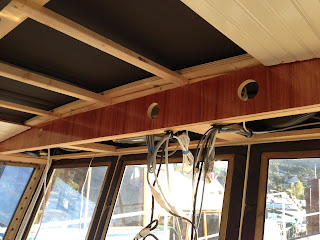
Worked this last weekend on wiring up the wiper motors and defroster fan in the wheelhouse. I also cleaned up the overhead wiring enough that I felt like I could close up the space with finished panels and not worry about it for a while. I went with flat black laminate over 1/2" plywood for the access panels to keep them light and to minimize the glare. There are three of these access panels, and each has a defroster vent centered over the window below. The fan coil unit in the overhead that feeds the vents is plumbed into the diesel furnace hydronic circuit. This will provide heat for de-fogging the windows either from the furnace, or from the engine cooling circuit (via a heat exchanger) when the engine is running. There are three settings on the blower, the highest of which draws 10 amps and puts out a lot of air. I'm feeling pretty good about where we are at with the wheelhouse console/helm/electronics package. That part of the boat is ready to go cruising...
We have begun collecting supplies and materials for the big winter job, which will be laying down the floors. I am going to start in the wheelhouse and work my way down the stairs to the galley, etc. The challenge with the floors will be the complicated shapes in the winding stairwell, and the 22 hatches (and a soft-patch in the wheelhouse deck) that all need to be framed out individually before the flooring goes down. I have this all pretty well thought out at this point. We'll see if it goes together as easily in the real world as it does in my head.
Tuesday, November 19, 2013
Sunday, November 3, 2013
Wipers
Looking for a quick weekend project, I pulled out the windshield wiper motors and hardware that's been taking up space on-board for about three years. The weather was nice and it seemed like a good time to put some holes in the boat. My biggest concern was getting a day with very light winds so I could contain all the steel shaving from the drill. Any metal bits that don't get swept or vacuumed up immediately will end up as a little rust stains on the deck, sometimes within 24 hours. To this end, I rigged up a little paper box that I hung under the drill. Hopefully I got it all... We are using pantograph type wiper arms. These use a dual linkage to keep the wiper blade vertical as it sweeps across the glass, providing much better coverage than a standard fan pattern wiper. Each wiper required a 3/4" hole for the motor and a smaller hole to secure the wiper arm baseplate. Their are four angles of sweep that you can set internally on the motor as well as a park function that can be set to put the blade to the left or right when off. Did my best to layout the height above the frame, motor sweep angle, and arm adjustment before drilling the holes. Fortunately (after some complications setting up the first motor) we found everything to be lined up pretty well, with good coverage and no wiper blade contact with the window frames. Kama Hele has a relatively high bow but doesn't really have much flare up forward, so I anticipate we might see a fair mount of salt spray on the wheelhouse windows. I'm eventually going to rig up some plumbing for rinsing the three front windows, with an on off valve at the helm. I had already fabricated a custom panel a while back that has wiper switches, and a defroster fan control. I'll be working on getting this wired up in the next week or so. That will just about do it for the wiring above the helm. I'll then be closing up the overhead with some removable panels trimmed out in matching black laminate to keep the reflections and glare down.
Sunday, October 27, 2013
Back to work
Right now it's cold and foggy and blowing about 30 knots out of the west. But all is quiet and warm in our boat, with the furnace running and the many layers of insulation proving to be well worth the grueling hours we spent installing them. Sue and I took a little time out to do some traveling for our 10th anniversary, with a little work mixed in. Lots of stories to tell, but probably not in this blog... I'll sneak in a few pictures though. We haven't completely neglected our boat project. While we haven't tackled anything big while we've been otherwise distracted, we have completed a lot of little projects over the past two months. The wheelhouse electronics are mostly finished except for the second VHF radio, and the hailer. The wiring is all pretty well cleaned up in the overhead and under the console. We got the chart plotter computer up and running with Rosepoint software and all the equipment is integrated and sharing info via NMEA 0183 which is an older but robust standard for exchanging data between devices. Since we don't have our masts installed yet, I did a temporary setup of all the antennas and receivers on the wheelhouse roof. It's all secured pretty well and should be fine for messing around in local waters until we get the final installation incorporated into the final rig. We also have all of our navigation lights installed now including an anchor light in case we can get away for an overnight trip this winter. I've been dealing with another geometry puzzle in the area of the stairwell leading from the wheelhouse down into the main cabin. Lots of angles and curves intersect in this area so the finish work is proving to be a challenge. So far it's coming together OK but I still need to make up some custom trim to tie it together in spots. This is also an area where we are fighting for inches to avoid any ergonomic oddities when going up and down the stairs. This will not be a boat for very tall people. Along with finishing out the stairwell, we added the veneer to the rest of the wheelhouse console.
The next big project is probably going to be flooring. The plywood subfloors are really not up to full time live-aboard use and it's about time we put something down for the finished floor. We've looked at a lot of options but haven't decided on what we will use. Right now, I'm looking into cork plank flooring. Good thermal and sound insulation, decent moisture resistance (won't warp or cup like wood floors) and supposedly durable if you get the right stuff.
Tuesday, August 27, 2013
Wheelhouse electronics
And now for something completely different... I've been working on installing all of the wheelhouse electronics that we've collected over the past couple of years. Most of it comes from commercial boats that were re-fit with the latest greatest stuff. The equipment removed at most commercial shipyards is still good, solid, serviceable equipment that has been surpassed by newer slicker technology. Some minor servicing was necessary (like installing new internal back-up batteries) but for the most part everything seems to work well. Our "surplus " package includes a 10kw Furuno radar with a 4 ft open array antenna, Furuno GPS, Depth Sounder, "Class A" AIS transceiver, and a fairly new Furuno Satellite Compass system. The Sat Compass uses three gps antennas mounted on an triangle shaped array to provide very accurate readings on course, position, speed, and roll/pitch. Being sattelite based, it is unaffected by magnetic interference or deviation. I will eventually get all this stuff integrated and talking to each other via NEMA 0183 interface and will feed this to a basic PC based chart plotter. You can see the screen for the chart plotter mounted on center over the helm chair. As a side note... we found an LED monitor for the chart plotting computer that runs off 14 volts DC. I am experimenting with bypassing the external brick type transformer that it came with, and powering it directly from the ships dc power (which runs about 13.2 volts) and it seems to be working well. This arrangement avoids going from ships DC, to Inverter AC, then back to DC through the power adapter that came with the monitor. I'll let you know if I end up blowing it up, but so far it does well with the range of DC it's seeing direct from the wheelhouse panel. Another nice thing about this monitor is that it has direct user controls for the internal backlighting which gives really good control over the brightness. This is a BIG DEAL when travelling at night offshore. You have to be able to get things very dark in the wheelhouse to see anything beyond the wheelhouse windows on a dark night. We are probably going to go with Rosepoint for charting software as it's a relatively "light" program as far as computer processing requirements, and works with a wide variety of electronic charts including the free ones available from NOAA. The program will also display AIS targets, depth, position, etc. with feeds from the various stand alone display units. The radar and Satellite compass antennas are just temporarily set on top of the wheelhouse for testing, but will eventually be mounted higher up and integrated with the aft mast. I also built some running light boxes out of aluminum scrap. These keep the glow from the running lights from lighting up the decks and surrounding superstructure. Again, important for maintaining your night vision. The running lights are LEDs so use very little juice, don't require heavy gauge wiring, and are disturbingly bright when viewed up close. They'll be hard to miss at night. Antenna mounts are integrated into the running light mounting brackets for now. Some of these antennas may move to the aft mast eventually. So... good progress on the electronics. Probably another weekend or two of fiddling around with the integration and cleaning up the wire runs. More to come on this part of the project.
Subscribe to:
Posts (Atom)